Trusted By
Life Insurers | Health Insurers | General Insurers | Reinsurers | Insurance Brokers
Traditional underwriting is burdened by manual data gathering, siloed assessments, and lengthy approval cycles. Underwriters spend the majority of their time on data entry and routine classification — not on the complex risk judgements they are trained for.
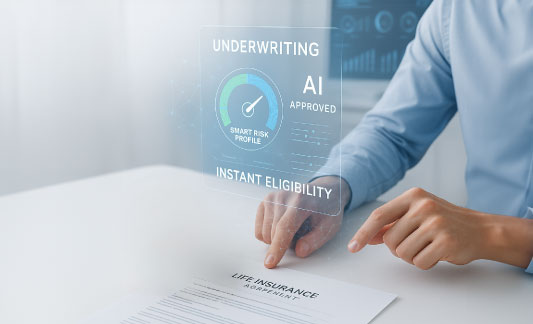
TruAI Underwriting is Datamatics' agentic AI accelerator that autonomously orchestrates the entire underwriting workflow. Intelligent agents ingest, validate, and analyse applications across medical, financial, and regulatory dimensions — delivering consistent, auditable decisions at scale.
Underwriting Lifecycle Automated
TruAI Underwriting delivers quantifiable improvements across every operational dimension that matters to insurers.
A comprehensive capability set designed to handle the full complexity of life, health, and general insurance underwriting.
TruAI Underwriting doesn't replace underwriters — it liberates them to do the high-value work that machines cannot.
From manual, Excel-driven workflows to autonomous, continuously learning agentic operations.
Explore our curated library of case studies, whitepapers, analyst insights, and practical guides on agentic AI in insurance underwriting.
Lorem ipsum dolor sit amet, consectetur adipiscing elit. Suspendisse tempor nisi ut vehicula commodo.
Learn More →
Lorem ipsum dolor sit amet, consectetur adipiscing elit. Suspendisse tempor nisi ut vehicula commodo.
Learn More →
Lorem ipsum dolor sit amet, consectetur adipiscing elit. Suspendisse tempor nisi ut vehicula commodo.
Learn More →
Lorem ipsum dolor sit amet, consectetur adipiscing elit. Suspendisse tempor nisi ut vehicula commodo.
Learn More →
Lorem ipsum dolor sit amet, consectetur adipiscing elit. Suspendisse tempor nisi ut vehicula commodo.
Learn More →
Lorem ipsum dolor sit amet, consectetur adipiscing elit. Suspendisse tempor nisi ut vehicula commodo.
Learn More →Decades-old systems weren't built for AI. Integration costs skyrocket while timelines slip quarter after quarter.
New AI regulations emerge monthly. One misstep could mean fines, lawsuits, or worse—total business shutdown.
Disconnected models, siloed data, incompatible platforms. Your AI stack is a patchwork that can't scale.
Everything you need to know before deploying agentic AI across your underwriting operation.
TruAI Underwriting is designed for life, health, and general insurance underwriting. The accelerator handles new business underwriting across individual and group policies, including medical assessment for life and critical illness covers, financial assessment for high-value proposals, and risk scoring for property and casualty lines. The modular agent architecture means capabilities can be configured to specific product lines and geographies.
TruAI Underwriting is built with API-first integration architecture, enabling connection to leading Policy Administration Systems (PAS), CRM platforms, and document management solutions. Datamatics provides pre-built connectors for major insurance platforms and a RESTful API layer for custom integrations. Implementation typically follows a phased approach, beginning with a parallel-run pilot before full production deployment.
For non-standard or complex cases — such as applicants with significant medical histories, high-value proposals, or unusual financial structures — TruAI Underwriting automatically routes cases to the human-in-the-loop review interface. This queue presents underwriters with a pre-populated case sheet, risk flags, and AI-generated recommendations, dramatically reducing the time expert underwriters need to reach a decision. The threshold for automated versus referred decisions is fully configurable by product line and risk level.
TruAI Underwriting is designed with compliance-by-design principles. All decisions carry a full audit trail, documenting the data inputs, guideline version applied, and reasoning path for every case. The platform supports configurable access controls, data residency requirements, and is architected to align with GDPR, FCA, IRDAI, and other relevant regulatory frameworks. Underwriting guidelines are version-controlled, with change management workflows governing updates.

Implementation timelines vary by complexity and integration scope, but most insurers achieve initial production deployment within 12–16 weeks. A phased rollout — beginning with document processing and extraction, followed by medical assessment and STP routing — allows teams to demonstrate ROI early. Most clients report measurable improvements in turnaround time within the first 90 days of live operation, with full efficiency gains realised at the 6-month mark.
Yes. TruAI Underwriting includes a Guideline Management module that enables your underwriting team to upload, structure, and maintain proprietary underwriting guidelines — including medical impairment manuals, loadings, exclusions, and acceptance criteria. These guidelines are ingested by the LLM agents and govern all automated decisions. Changes can be deployed immediately across all active workflows, with version control ensuring consistency and rollback capability.

Yes. The platform includes automated reinsurance referral workflows for cases that breach retention limits or meet pre-agreed facultative referral criteria. Case documentation, risk summaries, and supporting evidence are packaged automatically and routed to the relevant reinsurance partner, with tracking and response management built into the workflow.
Talk to our insurance AI specialists. We'll walk you through a live demo configured for your product lines and underwriting workflow — and help you model the ROI for your organisation.